
Receiving an ASMT-10 notice under GST can be concerning, particularly when it reports differences in turnover, tax liability or input tax credit. However, ASMT-10 is primarily a notice seeking an explanation for discrepancies identified during the scrutiny of returns; it is not a final tax demand. The notice is issued by the proper officer under Section 61 of the CGST Act read with Rule 99 of the CGST Rules.
A registered person may either accept the discrepancy and pay the applicable tax, interest and other amount, or submit an explanation in Form GST ASMT-11 along with supporting documents and reconciliations. A properly prepared reply should address every discrepancy separately and should be supported by figures that agree with the GST returns, books of account and relevant records.
This guide explains the meaning of an ASMT-10 notice, the applicable reply period, common discrepancies, documents required, the GST portal reply process and the possible consequences after submission.
1. What Is an ASMT-10 Notice Under GST?
Form GST ASMT-10 is a notice issued by the proper officer when a discrepancy is identified during the scrutiny of returns filed by a registered person. The scrutiny is conducted under Section 61 of the CGST Act, 2017, with reference to the returns and other information available to the department given by the person on GST Portal.
The notice specifies the period within which the registered person must respond in Form GST ASMT-11. The taxpayer should immediately check the reply date stated in the notice. The available time should be used to examine every discrepancy, reconcile the relevant returns with the books of account, collect supporting documents and prepare the explanation in Form GST ASMT-11.
Where additional time is genuinely required, a request should be made to the proper officer before the original deadline, explaining the reason for seeking further time. Extension should not be assumed unless it is permitted.
An ASMT-10 notice does not, by itself, represent a final determination of tax liability. The registered person is given an opportunity to examine the discrepancy, reconcile the relevant records and submit an explanation in Form GST ASMT-11. If the explanation is accepted, the proper officer communicates acceptance through Form GST ASMT-12.
2. Why Is ASMT-10 Issued?
An ASMT-10 notice is issued when the proper officer identifies a discrepancy while scrutinising the GST returns and information available for a registered person. The purpose of the notice is to obtain clarification before the department proceeds further.
During scrutiny, the officer may compare the information reported by the taxpayer across different returns, statements and other available records. A notice may therefore arise when figures do not match or when a transaction, tax payment, input tax credit claim, exemption or adjustment requires further explanation.
- Difference between turnover reported in GSTR-1 and GSTR-3B
- Difference between input tax credit claimed in GSTR-3B and reflected in GSTR-2A or GSTR-2B
- Tax liability appearing lower than the liability indicated by available records
- Incorrect or unexplained claim of exemption, deduction or zero-rated supply
- Difference between GST returns and e-way bill or e-invoice information
- Reverse-charge liability not reported or paid correctly
- Interest or late fee appearing unpaid
- Unusual adjustments or inconsistencies between different return periods
The existence of a difference does not always mean that tax has been short-paid. It may result from timing differences, amendments, reporting errors, credit notes or transactions reported in another tax period. Nevertheless, the reason must be explained clearly and supported by proper reconciliation.
3. Common Discrepancies Mentioned in ASMT-10
The exact discrepancy mentioned in ASMT-10 depends on the returns and information examined by the proper officer. The taxpayer should identify the source of each figure and reconcile it before accepting or disputing the proposed difference.
| Discrepancy mentioned | Records to examine |
|---|---|
| GSTR-1 turnover exceeds GSTR-3B turnover | GSTR-1, GSTR-3B, amendments, credit notes and tax-period workings |
| GSTR-3B ITC exceeds GSTR-2A/2B ITC | Purchase register, GSTR-2A/2B, invoices, debit notes and supplier filing status |
| E-way bill turnover exceeds reported turnover | E-way bill register, sales register, cancelled documents, delivery challans and non-supply movements |
| E-invoice data differs from GST returns | Invoice Registration Portal data, GSTR-1 and sales register |
| Reverse-charge liability appears unpaid | Expense ledgers, legal fees, freight and other applicable inward supplies |
| Exempt or zero-rated turnover requires clarification | Invoices, LUT, shipping bills, exemption notifications and supporting records |
| Interest appears payable | Date of liability, date of payment, electronic ledgers and return filing records |
Swipe or scroll the table horizontally to read both columns.
4. Time Limit for Replying to ASMT-10
Under Rule 99 of the CGST Rules, the registered person must submit an explanation within the period specified in Form GST ASMT-10. The period specified in the notice cannot exceed thirty days from the date of service, although a further period may be permitted by the proper officer.
The taxpayer should immediately check the reply date stated in the notice. The available time should be used to understand each discrepancy, reconcile the relevant returns with the books of account, collect supporting documents and prepare the explanation in Form GST ASMT-11.
The reply should preferably be submitted before the final date. After submission, the taxpayer should retain the acknowledgement, ASMT-11 reply, reconciliation workings and all uploaded attachments for future reference.
5. Documents Required for the Reply
The documents required for replying to an ASMT-10 notice depend on the nature of the discrepancy mentioned in the notice. The taxpayer should not upload unrelated records in bulk. Each attachment should support a specific statement or reconciliation provided in the reply.
The following documents may commonly be required:
- Copy of the ASMT-10 notice
- GSTR-1 and GSTR-3B for the relevant tax periods
- GSTR-2A or GSTR-2B, where the discrepancy relates to input tax credit
- Relevant annual return, wherever applicable
- Sales register and purchase register
- Trial balance and relevant ledger accounts
- Invoice-wise or month-wise reconciliation statement
- Copies of invoices, debit notes and credit notes
- E-way bill or e-invoice reconciliation, where relevant
- Electronic cash ledger, credit ledger or liability register
- Proof of tax and interest payment, including DRC-03 where applicable
- Export documents, LUT, shipping bills or exemption-related evidence, where relevant
- Written explanation addressing each discrepancy separately
Documents should be properly named and arranged in the same sequence as the discrepancies discussed in the reply. A summary reconciliation should clearly show the figure reported in the notice, the figure according to the taxpayer’s records, the resulting difference and the reason for that difference.
Where a payment has been made, the reply should mention the amount, payment date and relevant reference number. Where the discrepancy is disputed, the taxpayer should provide a clear explanation supported by reconciliation workings and relevant documentary evidence.
6. How to Reply to ASMT-10 on the GST Portal
A reply to an ASMT-10 notice is submitted electronically in Form GST ASMT-11 through the GST portal. Before starting the filing process, keep the written explanation, reconciliation statement and supporting documents ready in clearly named files.
Sign in to the GST portal
Visit the GST portal and log in using the taxpayer’s credentials.
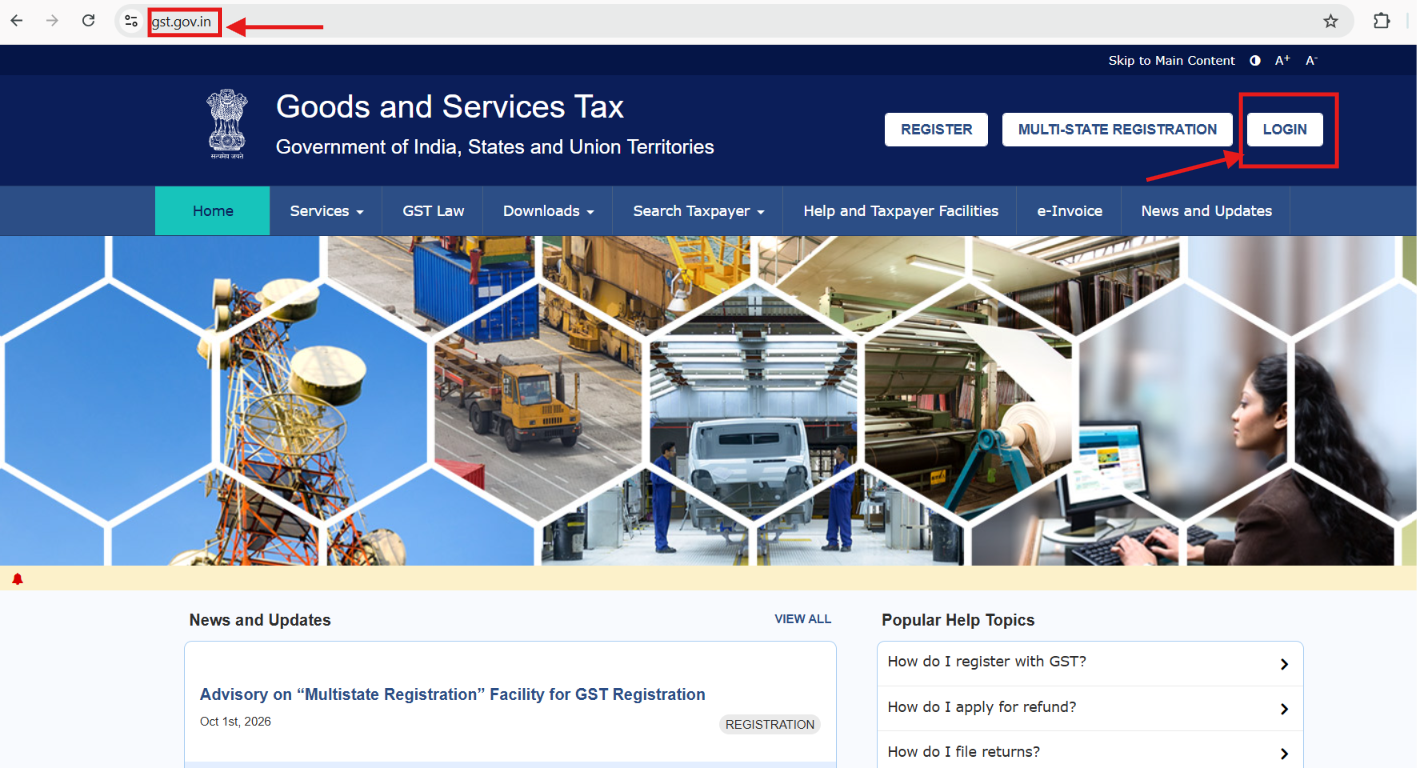
Open the official GST portal at gst.gov.in and select Login. 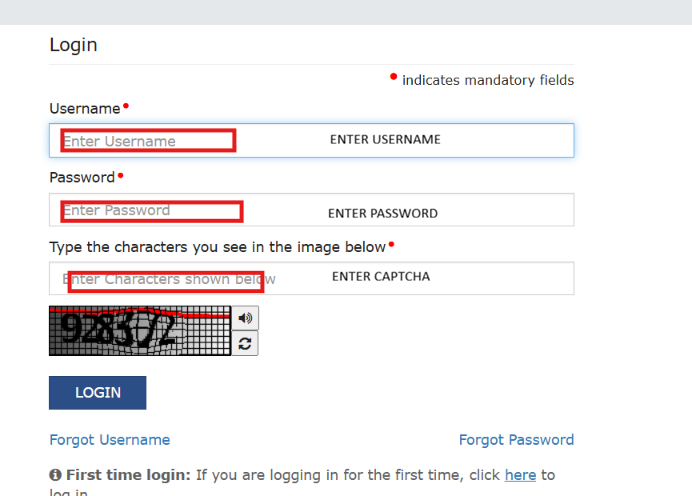
Sign in using the taxpayer’s credentials and the captcha shown on the portal. Open the notices menu
Navigate to Services → User Services → View Notices and Orders or View Additional Notices/Orders, as displayed for the proceeding.
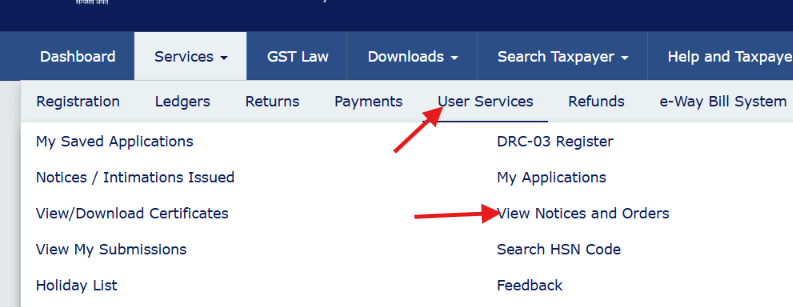
Select Services → User Services → View Notices and Orders, or the additional notices option shown for your proceeding. Locate the ASMT-10 notice
Locate the ASMT-10 notice using its reference number, issue date or financial year.
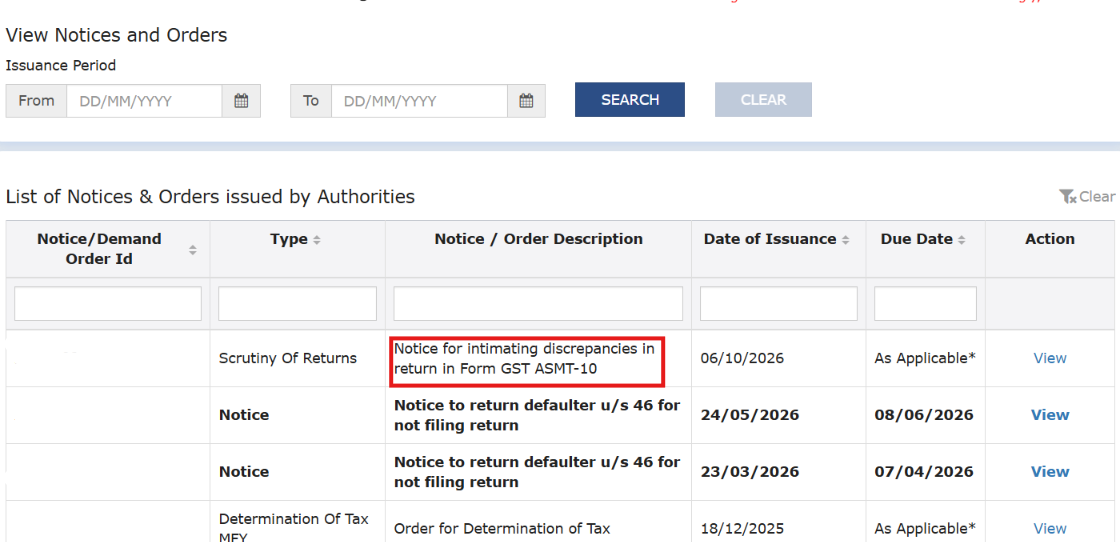
Identify the Form GST ASMT-10 scrutiny notice and select View. Notice IDs have been removed from this screenshot. Download the notice and annexures
Open the case details and download the notice and annexures, if not already available.
Select the reply option
Select the available option to file or furnish a reply against the notice.
Explain each discrepancy in ASMT-11
Enter the explanation in Form GST ASMT-11 and address every discrepancy separately.
Upload the supporting documents
Upload the reconciliation statement and relevant supporting documents.
Provide payment details where applicable
If the discrepancy has been accepted and payment made, provide the payment details and applicable DRC-03 reference.
Preview and verify the reply
Preview the reply and verify the amounts, tax periods and attachments carefully.
File using DSC or EVC
File the reply using the authorised signatory’s DSC or EVC, as applicable.
Preserve the reply and acknowledgement
Download and preserve the filed reply and acknowledgement.
The portal’s button names or screen arrangement may change. Therefore, the taxpayer should follow the options displayed against the relevant ASMT-10 proceeding rather than selecting an unrelated notice or application.
The explanation entered in the portal should remain concise. A detailed reply and reconciliation can be uploaded as attachments, but the portal text should briefly identify the discrepancy, the taxpayer’s explanation and the list of supporting documents.
7. How to Prepare the ASMT-11 Reply
Form GST ASMT-11 is used to communicate whether the registered person accepts the discrepancy mentioned in ASMT-10 or disputes it with an explanation. The reply should be based on the taxpayer’s actual returns, books of account and supporting records rather than a generic reply format.
1. Identify the notice
Mention the ASMT-10 reference number, date, relevant financial year or tax period and GSTIN.
2. Provide a brief background
Briefly describe the taxpayer’s business and acknowledge receipt of the notice. Avoid adding facts that are unrelated to the discrepancy.
3. Reply to each discrepancy separately
Reproduce or summarise each discrepancy exactly as mentioned in the notice. Provide the explanation immediately below it so the proper officer can easily match the reply with the notice.
4. Provide a reconciliation
Show the figure stated in ASMT-10, the figure according to the taxpayer’s records, the difference and the reason for the difference. Where necessary, provide invoice-wise or month-wise workings.
5. State whether the discrepancy is accepted
If the discrepancy is correct, mention the tax, interest or other amount paid and provide the relevant payment reference. If it is disputed, explain the factual and legal basis and refer to the supporting documents.
6. List the attachments
Number every attachment and mention it against the corresponding explanation. Use clear filenames such as “Annexure-1_GSTR1_vs_3B_Reconciliation.”
7. Make a clear request
Conclude by requesting the proper officer to accept the explanation and conclude the scrutiny proceedings where the discrepancies have been properly explained.
| Particulars | Amount/Explanation |
|---|---|
| Amount stated in ASMT-10 | ₹_____ |
| Amount as per taxpayer’s records | ₹_____ |
| Difference | ₹_____ |
| Reason for difference | Timing difference/reporting error/amendment/other verified reason |
| Supporting document | Annexure _____ |
Swipe or scroll the table horizontally to read both columns.
8. Sample ASMT-11 Reply and Reconciliation Example
The following samples show how to organise an explanation and link it to supporting records. The reply uses placeholders, and the worked example uses fictional figures for learning. Adapt every statement to the notice and verified documents.
Sample ASMT-11 Explanation
The official ASMT-11 form includes taxpayer and notice details, responses to discrepancies, amounts accepted and paid, and verification. The text below is an illustrative accompanying explanation.
Repeat the discrepancy-specific explanation for every point in the notice. File through the prescribed ASMT-11 process and complete the portal's required fields and verification.
Worked Reconciliation Example
Illustrative scenario: GSTR-1 shows turnover of ₹5,00,000 and GSTR-3B shows ₹4,50,000 for the same period. An invoice-by-invoice review identifies a duplicate GSTR-1 entry of ₹50,000. For this example, assume the return data, sales register and invoice establish that duplication.
| Reconciliation item | Amount / supporting record |
|---|---|
| Turnover reported in GSTR-1 | ₹5,00,000 - return data |
| Turnover reported in GSTR-3B | ₹4,50,000 - filed return |
| Apparent turnover difference | ₹50,000 - ₹5,00,000 less ₹4,50,000 |
| Duplicate entry identified in this example | ₹50,000 - invoice and sales-register reconciliation |
| Balance still requiring explanation in this example | ₹0 - after matching the identified difference |
Swipe or scroll the table horizontally to read both columns.
How to use the example: Attach the invoice-level comparison and point to the duplicate entry in the explanation. Verify the required reporting correction and any tax or interest separately. A zero unexplained turnover balance does not, by itself, establish that nothing is payable.
9. Real-World Example: ITC from a Supplier Whose Registration Was Cancelled
In a recent ASMT-10 notice handled at our office, the department questioned input tax credit of approximately ₹77,000 claimed during FY 2025–26. The invoices had been issued by a supplier whose GST registration was shown as cancelled retrospectively from a date preceding the invoices.
The notice treated the supplier as suspicious and required the taxpayer either to pay the disputed tax with applicable interest or provide an explanation in Form GST ASMT-11.
At the time of writing, the taxpayer’s supporting documents had not been received and no ASMT-11 reply had been filed. Therefore, this example does not express a conclusion regarding the taxpayer’s eligibility for input tax credit. It demonstrates the verification required before preparing a reply.
Documents to Be Verified
- Purchase invoices mentioned in the notice
- Appearance of the invoices in GSTR-2A or GSTR-2B
- Supplier ledger in the taxpayer’s books
- Proof of payment through the banking channel
- E-way bills, transport receipts or delivery documents
- Stock register and evidence of receipt or consumption of goods
- Corresponding sales or use of the goods in the business
- Supplier’s registration status and effective cancellation date
- Purchase register and relevant GSTR-3B returns
- Any communication with the supplier
Practical Approach Before Filing ASMT-11
The discrepancy should not be accepted or disputed without examining the underlying transactions. If the taxpayer can establish genuine receipt of goods or services, payment to the supplier and compliance with the applicable input tax credit conditions, those records should be organised invoice-wise and submitted with the explanation.
If the client cannot provide evidence supporting the purchases, the professional should explain the resulting exposure and calculate the tax and interest implications before any admission or payment is made.
10. What Happens After Submitting the Reply?
After Form GST ASMT-11 is submitted, the proper officer examines the explanation, reconciliation and supporting documents provided by the registered person.
If the explanation is found satisfactory, the proper officer communicates acceptance through Form GST ASMT-12. This form confirms that the reply has been accepted and that no further action is required regarding the discrepancies covered by that scrutiny proceeding.
If the taxpayer has accepted a discrepancy and paid the applicable tax, interest or other amount, the officer may verify the payment details and whether the necessary corrective action has been completed.
The taxpayer should continue monitoring the proceeding on the GST portal because an acknowledgement of filing does not itself mean that the explanation has been accepted. The proceeding is satisfactorily concluded when the appropriate communication, such as ASMT-12, is issued by the proper officer.
CBIC confirms that when an explanation is accepted, the taxpayer is informed through Form GST ASMT-12, and no further action is required in that matter.
11. What Happens If the Reply Is Not Accepted?
If the proper officer is not satisfied with the explanation submitted in Form GST ASMT-11, the scrutiny proceeding may lead to further action under the CGST Act. The taxpayer may be required to provide additional clarification or face proceedings under the applicable audit, investigation or tax-demand provisions.
Depending upon the facts of the case, the proper officer may initiate:
- Audit proceedings under Section 65
- Special audit proceedings under Section 66
- Inspection, search or seizure proceedings under Section 67
- Proceedings for determination of tax under the applicable demand provisions
ASMT-10 itself is not a final demand order. Before any disputed tax is finally determined, the department must follow the applicable statutory procedure and provide the taxpayer with an opportunity to respond.
A weak, incomplete or unsupported reply may increase the possibility of further proceedings. Therefore, every discrepancy should be reconciled properly, and the explanation should clearly establish whether the difference is accepted, corrected or disputed.
12. Practical Mistakes to Avoid
Many ASMT-10 replies become ineffective not because the taxpayer has no valid explanation, but because the reconciliation is incomplete or the supporting documents are poorly organised. The following mistakes should be avoided:
- Ignoring the deadline mentioned in the notice
Delayed filing may result in further proceedings before the explanation is properly considered. - Submitting a generic reply
Every discrepancy should be answered separately with relevant figures and supporting evidence. - Using figures from the wrong financial year
Confirm the tax period, financial year and return period before preparing any reconciliation. - Replying without reconciling the returns
Verify GSTR-1, GSTR-3B, GSTR-2A/2B, books of account and other applicable records. - Accepting the entire discrepancy without verification
Differences may arise from amendments, credit notes, timing differences, cancellations or reporting in another tax period. - Uploading excessive but irrelevant documents
Each attachment should support a specific explanation given in the reply. - Not explaining the reconciliation clearly
Show the notice figure, taxpayer’s figure, difference and reason in a simple table. - Quoting unverified sections, notifications or judgments
Check every legal reference through an official or reliable source before including it. - Failing to mention payment details
If any amount has been paid, provide the amount, date and relevant payment or DRC-03 reference. - Not retaining proof of submission
Download the acknowledgement, filed ASMT-11, attachments and subsequent communication from the portal.
A concise and properly indexed reply is generally easier to examine than an unnecessarily lengthy submission. The objective should be to help the proper officer understand the discrepancy, reconciliation and supporting evidence without confusion.
13. Frequently Asked Questions
What is an ASMT-10 notice under GST?
ASMT-10 is issued by the proper officer when a discrepancy is identified during the scrutiny of a registered person’s GST returns under Section 61 of the CGST Act.
Which form is used to reply to ASMT-10?
The taxpayer submits the explanation in Form GST ASMT-11 along with the applicable reconciliation and supporting documents.
What is the time limit for replying to ASMT-10?
The explanation should be submitted within the period specified in the notice, which cannot exceed thirty days from the date of service. A further period may be permitted by the proper officer.
Is ASMT-10 a final GST demand order?
No. ASMT-10 communicates discrepancies identified during scrutiny and seeks an explanation. It is not, by itself, a final determination or demand order.
Can the taxpayer accept only part of the discrepancy?
The taxpayer can respond to each discrepancy separately. Any amount that is accepted should be properly calculated and paid, while disputed amounts should be supported by a clear explanation and relevant evidence.
What happens when the ASMT-11 reply is accepted?
If the explanation is found satisfactory, the proper officer communicates acceptance in Form GST ASMT-12, indicating that no further action is required regarding the accepted explanation.
What happens if no reply is submitted?
Failure to provide a satisfactory explanation or take the required corrective action may lead to further proceedings under the applicable provisions of the CGST Act.
Should all purchase and sales invoices be uploaded?
Not necessarily. Upload the invoices and transaction-level records relevant to the discrepancy. A properly prepared reconciliation with clearly identified supporting documents is generally more useful than uploading unrelated records in bulk.
Can AI prepare an ASMT-11 reply?
AI may help organise the draft and improve its language, but it should not determine the facts, figures or legal position. The taxpayer or authorised professional must verify every reconciliation figure, legal reference and supporting document before filing.
Is professional assistance necessary?
It depends on the nature and value of the discrepancy. Professional review may be advisable where the notice involves substantial tax, disputed input tax credit, multiple return periods or complex legal issues.
14. Conclusion
An ASMT-10 notice should not be ignored, but it should also not be treated as a confirmed tax demand without examining the discrepancy. The first step is to compare the figures mentioned in the notice with the relevant GST returns, books of account and transaction-level records.
In my experience, a clear point-wise explanation supported by a simple reconciliation is more effective than a lengthy reply containing unrelated documents. Where a difference is correct, the applicable liability should be calculated properly. Where it is disputed, the reason must be supported by reliable evidence.
Every ASMT-10 notice depends on its own facts. Therefore, the taxpayer should verify the tax period, figures, legal provisions and reply deadline before submitting Form GST ASMT-11. The filed reply, acknowledgement and any subsequent ASMT-12 communication should also be preserved for future reference.
15. Need Help Replying to an ASMT-10 Notice?
Tax & Tenders can help review your GST scrutiny notice, reconcile returns with your books, and prepare a point-by-point reply supported by relevant documents.
For your consultation, keep the notice and annexures, reply deadline, relevant returns and reconciliation records ready.
17. Disclaimer
This article is intended for general informational purposes and is based on the provisions and portal procedures available on the date of review. It should not be treated as legal or professional advice for any particular case. The appropriate response to an ASMT-10 notice depends on its facts, tax period, discrepancies and supporting records. Readers should verify subsequent amendments and obtain professional assistance where necessary.
18. Official References
- Section 61 of the CGST Act – Scrutiny of Returns
- Rule 99 of the CGST Rules – Scrutiny of Returns
- CBIC Instruction No. 02/2023-GST – Scrutiny of Returns for FY 2019–20 Onwards
- GST Portal – View Notices and Orders
The legal provisions and portal procedures referred to in this article should be checked for subsequent amendments and system changes before being applied to a particular case.